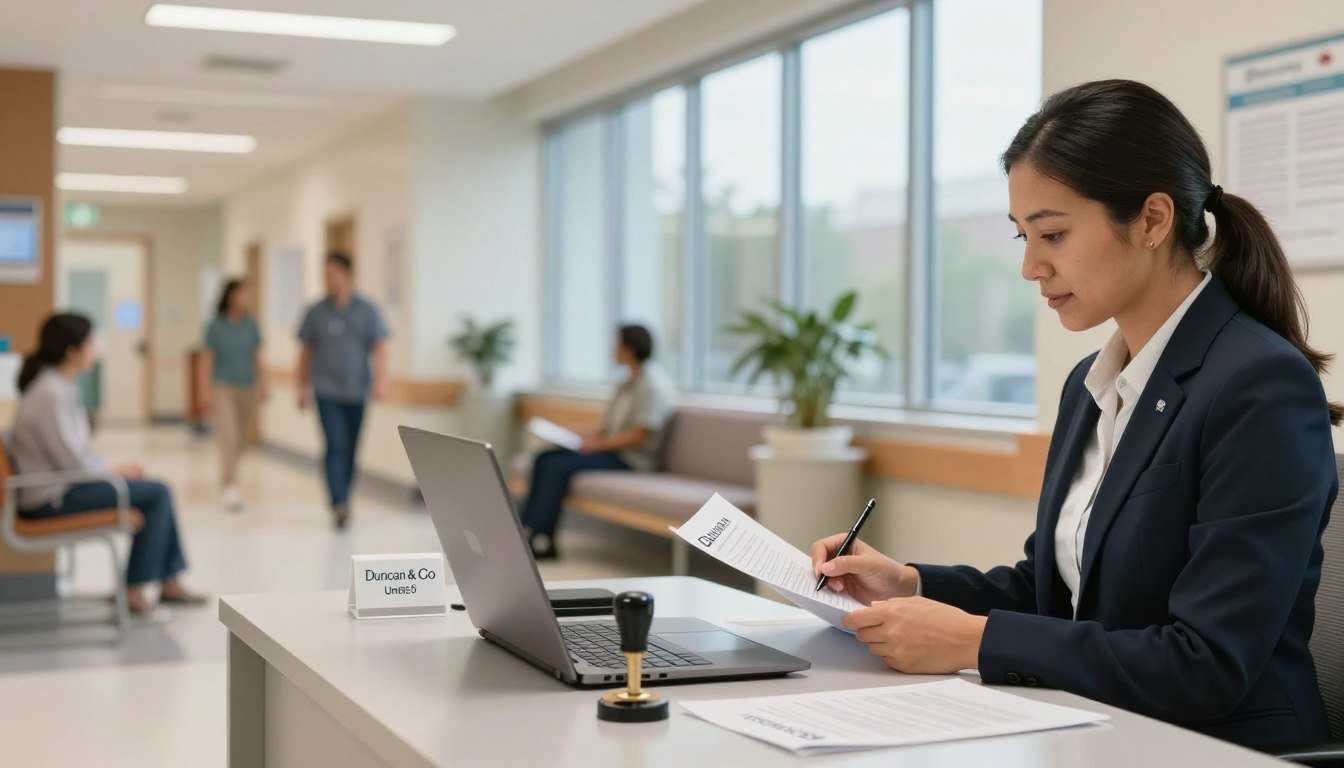
I remember sitting at a bedside while my family rushed through papers, hearts racing and time slipping away. That urgent mix of care plans, medical choices, and legal forms can feel overwhelming.
Get My Legal Path sends bonded, insured mobile notaries to a patient’s bedside for on-demand hospital notarization during emergencies and hospice transitions.
The difference between a routine signing and bedside notarization is clear: schedules change fast, privacy matters, and every decision carries weight.
If you need prompt help, call or text 3038270632 or stop by 350 Terry St Ste 229, Longmont CO 80501. We coordinate calmly and professionally to reduce friction when health and timing are the priorities.
On this page we will explain bedside logistics, capacity requirements, common healthcare documents, fees and timing, and the risk-management steps we take to protect patients and families.
Key Takeaways
- On-demand bedside notarization for time-sensitive medical and legal needs.
- Mobile professionals are bonded, insured, and trained for high-stakes settings.
- Ideal for families, caregivers, and those protecting a loved one’s wishes.
- Clear call-to-action: call or text 3038270632 or visit 350 Terry St Ste 229.
- Page will cover logistics, required capacity, common documents, fees, and protections.
Mobile hospital notary in Longmont for urgent patient document signings
When minutes matter, we bring the signing to the bedside so families can focus on care.
Call or text 3038270632 for bedside notarization support and immediate scheduling guidance.
We travel to the patient’s room so people do not face transport or mobility limits. This cuts time, reduces stress, and respects visiting rules.
For planned or non-urgent needs, visit our office at 350 Terry St Ste 229, Longmont CO 80501 for in-person assistance.
“We coordinate around treatment schedules and nursing workflows so signings cause minimal disruption.”
Our team verifies identity and willingness, then completes the document signing. Families should have the papers ready; we cannot draft forms or give legal advice.
- We handle emergency and hospice transitions with care and fast coordination.
- We work with facility limitations and plan document return if relatives cannot be present.
- Serving patients and the wider community of northern colorado with local, timely support.
| Option | Where | Best for |
|---|---|---|
| Mobile bedside | Patient room | Emergencies, limited mobility |
| Office visit | 350 Terry St Ste 229 | Planned signings, non-urgent documents |
| Document return | Coordinated pickup/mail | When family cannot attend |
Call or text 3038270632 for bedside notarization support
Visit our office at 350 Terry St Ste 229, Longmont CO 80501
Helping families during medical emergencies, hospice transitions, and time-sensitive care decisions
Hospital Notary Services in Longmont (UCHealth/Longmont United)
Many urgent signings take place inside critical care areas such as the ICU, PACU, and inpatient wards.
Where notarization happens most often
Families most commonly request bedside signings in the ICU, the post-anesthesia care unit (PACU), hospice suites, and general inpatient rooms.
These areas require sensitivity and fast coordination due to medical equipment and treatment schedules.
Coordinating with hospital staff for the right timing
We work with social workers, patient advocates, and nursing teams to find a safe window for signing.
Check-in rules, unit access, and staff workflows often require preclearance and precise timing.
Privacy-first approach
“We keep the footprint small, speak softly, and protect patient dignity during every signing.”
Privacy matters: low voice, minimal items at the bedside, and respectful handling of sensitive health information.
| Location | Typical Access | Best Timing |
|---|---|---|
| ICU | Restricted, requires staff escort | Avoid rounds and procedures |
| PACU | Controlled recovery area | After stabilization and nurse approval |
| Hospice & Inpatient | Standard unit check-in | When patient is comfortable and alert |
Why healthcare notarization requires a specialized notary team
When treatment plans shift by the hour, a specialized team keeps paperwork accurate and timely.
Understanding facility protocols, patient comfort, and changing treatment schedules
Working in clinical areas often require strict check-in, staff coordination, and quiet handling of personal items.
That means the signing team must move with the care flow and respect visiting rules and equipment around the bedside.
Patient capacity standards and willingness to sign
Capacity is simple: the person must be alert, aware, able to communicate, and willing to sign at that point.
If any of those elements are missing, the team pauses and documents why the signing cannot proceed.
Reducing risk for all parties involved
“A neutral, procedural approach protects patients, families, clinicians, and outside counsel when high-stakes decisions are at risk of being contested.”
Following clear steps lowers future challenges to end-of-life or treatment preferences.
- Neutral role: the team does not advise — it verifies identity and willingness.
- Speed with care: rapid coordination helps during an emergency without cutting corners.
| Challenge | How we address it | Benefit |
|---|---|---|
| Rapid treatment changes | Flexible scheduling and staff coordination | Faster completion, less delay |
| Questioned capacity | Documented observations and pauses | Reduced legal risk |
| Multiple parties involved | Clear records and neutral process | Stronger evidence of voluntary decisions |
Common hospital documents we notarize for patients and families
When treatment choices must be clear and actionable, a handful of documents appears most often at the bedside.
Advance directives and living wills
Advance directives and living wills record a person’s life-sustaining treatment preferences.
They guide clinicians and loved ones when the patient cannot speak for themselves.
Healthcare power of attorney
A healthcare power of attorney names a trusted decision-maker to act on behalf of the patient.
This document simplifies choices during fast-moving medical events.
DNR and POLST forms
DNR and POLST are time-sensitive instructions used during emergencies and end-of-life care.
They help first responders and clinical teams follow the patient’s stated wishes immediately.
HIPAA and medical records releases
HIPAA releases and medical records release forms let families access vital health information.
These authorizations keep care coordination moving without unnecessary delay.
Affidavits of incapacity and sworn statements
Affidavits of incapacity and other sworn statements support legal actions tied to treatment and decision-making.
Accurate notarization ensures these records hold weight if challenged later.
“Clear, properly executed documents protect patient wishes and reduce confusion during stressful moments.”
| Document | Purpose | Typical urgency |
|---|---|---|
| Advance directives / Living will | Record life-sustaining treatment preferences | High — when prognosis changes |
| Healthcare power of attorney | Appoint medical decision-maker | High — if patient lacks capacity |
| DNR / POLST | Emergency and end-of-life instructions | Immediate — during rapid decline |
| HIPAA / Medical records release | Authorize information sharing | Medium — for coordination |
Compliance reminder: we verify identity and witnessing, but we do not draft documents or give legal advice about what someone should sign.
What to prepare before the notary arrives at the hospital
Before the team arrives, a short checklist prevents delays and protects the patient’s wishes.
Confirm capacity: make sure the patient is alert, aware, able to communicate, and willing to sign at the scheduled point.
Have documents ready: notaries cannot draft forms or provide legal advice. Bring the completed paperwork and any required attachments so the visit is efficient.
Witness and facility rules: many facilities limit staff from acting as witnesses. Arrange independent witnesses ahead of time and check unit policies to avoid last-minute refusals.
Day-of checklist
- Valid ID for the signer at the signing point.
- Unsigned document ready to be signed.
- Two witnesses if facility policy requires them.
- Coordination with the nurse’s station to pick a low‑conflict time.
If family cannot attend
Decide how the document will be returned (UPS, FedEx, or mail) and who will receive it. Expect possible extra fees for shipping or holding. Clear plans reduce repeated trips and help staff provide timely support.
“Preparation protects patients, families, clinicians, and the team by minimizing delays during urgent moments.”
Fees, timing, and the medical convenience factor in hospital settings
Complex medical facility layouts and security checkpoints add steps that affect arrival and completion time.
Why hospital notarizations can require extra coordination, navigation, and clearance
Transparent fee structure: a standardized medical convenience fee covers parking, security clearance, and extra walking or waiting inside a large medical facility.
This fee reflects real costs and helps keep final charges predictable for families and referring professionals in the community.
How we minimize delays when time is critical for treatment and care decisions
Timing often depends on medication effects, procedures, therapy schedules, or visiting rules. Those factors can change at a moment’s notice.
To reduce delay we confirm unit access before arrival, coordinate with staff, and go straight to the exact signing point. That saves time while keeping checks thorough.
- Clear coordination: precheck access and expected windows with clinical teams.
- Efficient movement: targeted routing inside the facility to reach the bedside fast.
- Safety first: speed never replaces capacity checks, identity verification, or privacy protections during notarization.
| Reason | What it covers | Benefit |
|---|---|---|
| Security & access | Clearance, escorts | Faster, authorized entry |
| Parking & navigation | Transport time inside campus | Predictable arrival windows |
| Coordination with staff | Aligning with treatment timing | Minimized interruptions to care |
“Fees reflect logistics, not surprises—so families can focus on care and timely decisions.”
Risk management and insurance protections for hospital notarizations
High-risk healthcare signings demand more than a stamp—they require documented protection and accountability.
The $6,000,000 professional liability policy advantage
Get My Legal Path maintains a $6,000,000 professional liability policy to cover complex medical notarization events. Many independent practitioners carry as little as $10,000 in Errors & Omissions insurance.
The difference matters. Documents executed during urgent care or end-of-life decisions can be reviewed later by courts or counsel. Higher coverage reduces financial exposure and supports clearer remedies if a claim arises.
Peace of mind for families, law firms, and medical facilities
Robust insurance helps medical facilities and law firms approve outside signers with confidence. It signals process discipline and accountability when records affect treatment or estate outcomes.
- Reduces risk by backing professional actions with significant coverage.
- Supports faster institutional approval for bedside signings and facility access.
- Offers families measurable reassurance during stressful decisions.
| Coverage | Typical independent | Get My Legal Path |
|---|---|---|
| Errors & omissions | $10,000 | $6,000,000 professional liability |
| Institutional confidence | Limited | High |
| Support for contested signings | Low | Strong |
“Insurance and clear procedures protect patients and families while giving facilities the assurance they need.”
Beyond coverage, the team follows strict capacity checks and facility protocols to lower preventable risk. That combination—insurance plus disciplined process—delivers real peace of mind when health decisions matter most.
Options for isolation units and language access in Northern Colorado
In modern care settings, safety protocols often limit who can enter certain rooms.
Remote Online Notarization for restricted-access, quarantine, or isolation rooms
Remote Online Notarization (RON) lets patients complete required documents via secure video when physical entry is blocked.
Colorado RON uses a tablet or laptop and follows state identity and recording rules. Staff can hold the device while the signer participates from an isolation room.
Expectations: confirm device availability, test connectivity, and schedule a short window so care is not disrupted.
Bilingual Spanish support to ensure clear understanding
Clear language access reduces mistakes and stress. Bilingual Spanish staff provide live interpretation and plain-language guidance during the session.
This support protects dignity and helps people make informed choices while keeping the process compliant and professional.
| Option | How it works | Best when |
|---|---|---|
| Restricted‑access on site | Facility escort with PPE | Staff permits bedside entry |
| Remote Online Notarization | Secure video on tablet/laptop | Quarantine or visitation limits |
| Bilingual Spanish support | Live interpretation during session | Non‑English speakers or stressed families |
Local coverage: we offer RON and language support across northern colorado to help families and clinical teams when time and access matter.
Conclusion</h2>
When medical choices move fast, having a trained team ready to complete paperwork at the bedside brings relief.
Core benefit: specialized support that helps families finalize critical decisions with a privacy-first, protocol-aware approach. This protects patient dignity and speeds needed action during sudden changes in health or hospice transitions.
Next steps: call or text 3038270632 to schedule bedside assistance, or stop by 350 Terry St Ste 229, Longmont CO 80501 for an office visit.
Before arrival, confirm the signer is alert and willing, have completed papers ready, and check witness rules with the facility. Typical forms include advance directives, healthcare power of attorney, DNR/POLST, HIPAA/medical records releases, and affidavits of incapacity.
We serve the local community with calm, professional help designed to reduce stress, protect comfort, and ensure critical paperwork is completed correctly and on time for the broader community’s peace of mind.
Leave a Reply