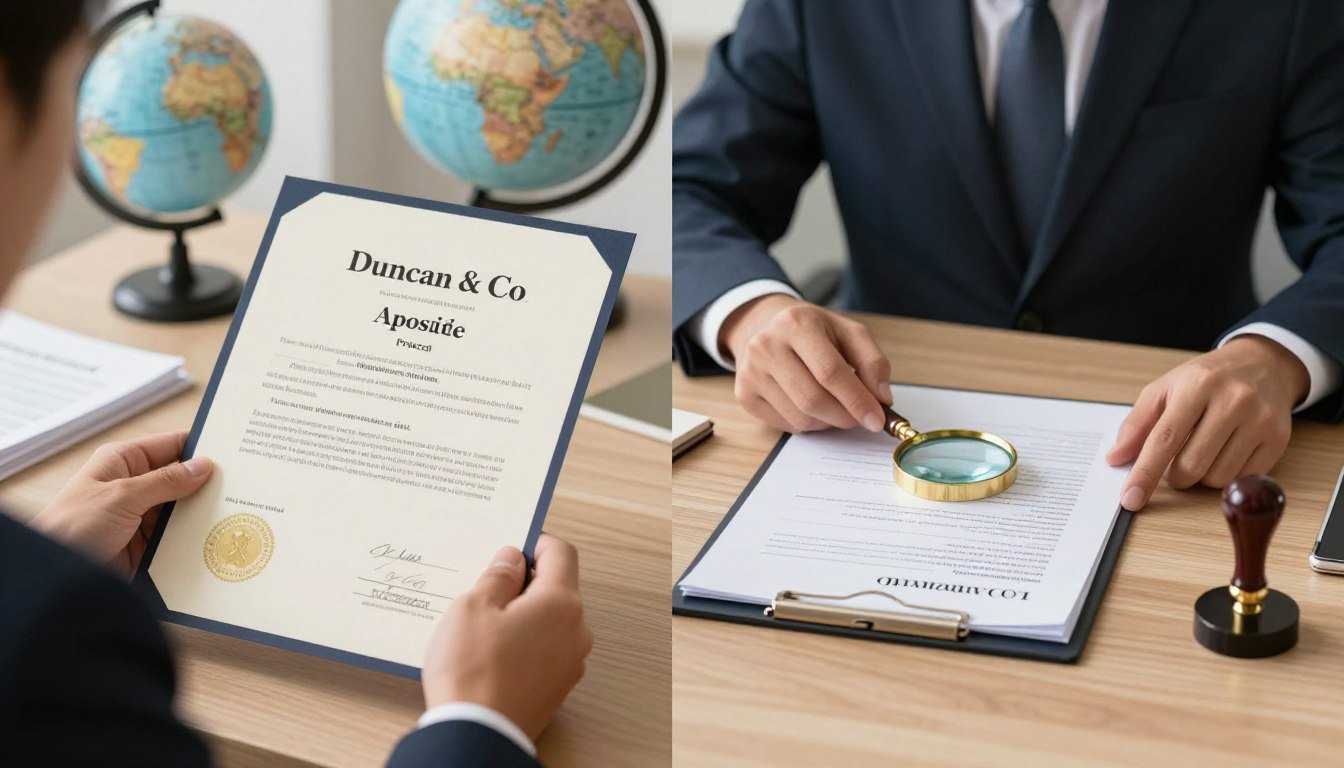
You may feel a knot in your stomach when a foreign office asks for a specific seal on your U.S. documents. I have seen people miss flights, lose job offers, and delay adoptions because they chose the wrong path.
In plain terms, one process lets papers move quickly between countries in the Hague network, while the other adds steps for nations outside that group. Many confuse the two because both prove a document is real.
This guide shows which route fits your destination, what seals or certificates matter, and why mixing them up can cause rejection and wasted time. For quick help, call or text 3038270632 or stop by 350 Terry St Ste 229, Longmont CO 80501.
Key Takeaways
- Choose the right certificate based on whether your destination follows the Hague Convention.
- Using the wrong seal can lead to rejection, rework, and delays.
- Common U.S. documents need either a streamlined certificate or added consular steps.
- This guide will cover step-by-step flows, timing, and frequent mistakes.
- Contact our office by phone or visit for help verifying requirements.
- Knowing which option to use first saves time and stress.
Why document certification matters for international use
Many foreign offices demand extra certification before they will accept a U.S. document for official use.
International recipients — banks, registries, courts, universities, and immigration offices — often ask for certified papers because a domestic seal is not enough proof abroad. They need a clear link from a local authority to the original signature or stamp.
Common situations that trigger certification needs
- Opening a foreign bank account for your business.
- Registering a subsidiary or filing articles of incorporation overseas.
- Proving corporate authority with governance documents and minutes.
- Submitting school records, court papers, or immigration paperwork to a foreign office.
What can happen if your papers are rejected abroad
Rejection has real costs. Missed closings, delayed onboarding, postponed visas, and extra courier fees add up fast.
“A single wrong seal can render a document unusable and force a full resubmission.”
Rules vary by country and can change without notice. Some requests take one step and a few days; others take weeks with multi-step reviews and embassy appointments. Careful prep up front reduces total time and prevents rework.
What is an apostille in the United States?
For documents bound for Hague-member countries, a single attached certificate can replace long legalization chains.
How the Hague Apostille Convention simplifies the process
An apostille is a standardized certificate that confirms a signature, seal, or stamp on a public document. It lets many foreign authorities accept U.S. papers without extra embassy steps.
Who issues apostilles: Secretary of State office vs. federal authorities
Most state-level apostilles come from a secretary state office or state office that handles public records. Certain federal documents use federal routes, such as U.S. court clerks or the U.S. Department of State.
When an apostilled document typically does not need embassy or consulate legalization
Apostilled documents generally do not need consular legalization when the destination follows the hague convention. In practice, that means one certificate often suffices.
- Look for a readable certificate attached to the paper.
- Confirm destination rules—exceptions exist.
- If the country is a Hague member, an apostille is often the fastest route.
| Document Type | Typical Issuer | Need for Consular Steps |
|---|---|---|
| State birth or marriage records | Secretary of State office | No, if destination is Hague member |
| Federal court orders | Federal court clerk or Dept. of State | Usually no for Hague members; check specifics |
| Notarized business papers | State office or secretary state | No for many Hague destinations; verify format |
What is document authentication (and how legalization fits in)?
For non-member destinations, U.S. papers usually need a federal chain of checks and a foreign office stamp.
Document authentication in the U.S. is the certification chain used when a country will not accept a standardized apostille. It begins with a notary or issuing authority, moves through state or county review when required, and often ends with federal certification.
Why this process is not interchangeable with an apostille
Which route you use depends on the destination’s status, not your preference. Using the wrong method can lead to rejection and rework.
Legalization: the embassy or consulate final step
After U.S. steps finish, many countries require legalization at an embassy or consulate. That foreign office adds a stamp or sticker that allows the document to be used inside its borders.
Where the U.S. Department of State Office of Authentications fits in
The Department State office provides federal-level certification that many embassies require before they will legalize papers. Some consulates insist on that federal check first.
| Step | Typical U.S. Authority | Purpose |
|---|---|---|
| Notarization | Notary public | Confirm signature and identity |
| State/County certification | County clerk or state office | Verify notary authority and record |
| Federal authentication | Department State Office | Certify state action for foreign use |
| Legalization | Foreign embassy or consulate | Final acceptance stamp for use in that country |
Note: Each embassy consulate sets its own rules, fees, and timing. Confirm requirements before you begin to avoid delays.
Next, we compare apostille vs. authentication by countries involved, steps, timing, and final acceptance.
Apostille vs Authentication: What’s the difference?
Your first move is to confirm the recipient country’s rules—this single check directs every next step.
Countries involved
Some countries belong to a convention that accepts a single standardized certificate. Other countries do not. If the destination is a member, you often need only that certificate. If not, you follow a longer path that ends at an embassy or consulate.
Steps and authorities
State office or secretary state handles many state-issued papers. Federal items go through the Department State for a national check. For non-member countries, a foreign embassy or consulate adds final legalization.
Timing expectations
A one-step certificate is usually faster. Multi-step authentication plus consular legalization can take weeks. Processing time varies by state office, federal queues, and embassy schedules.
End result and decision filter
You will receive a readable certificate or a consular seal that the receiving authority recognizes. To decide, confirm country rules first, then classify your document as state-issued, notarized private, or federal.
“Confirm the destination’s requirement before you start — it saves time and prevents rework.”
| Scenario | Typical Authority | Expected Timeframe |
|---|---|---|
| Hague-member country | Secretary of State or federal office | Few days to 2 weeks |
| Non-member country | Department State + embassy/consulate | 2–8+ weeks |
| Federal document for member | Federal clerk or Dept. State | 1–3 weeks |
Which documents can be apostilled or authenticated?
Start by sorting your paperwork into three clear groups so you can follow the right certification path.
Public documents and state-issued certificates
Public documents include vital records, court orders, and certificates of good standing. These are official from a government office and usually go straight to state certification.
Non-governmental business paperwork
Business papers — powers of attorney, corporate resolutions, bylaws, and bank letters — often may require notarization first. A notary links the signer to the document before any further certification.
Federal documents and special paths
Federal documents such as FBI checks, IRS forms, and federal court records follow different federal certification steps. They may need a national office review before any foreign acceptance.
Copies versus originals: Many countries reject plain photocopies. Certified copies or originals are usually required.
Quick checklist to classify your document:
- Was it issued by a government office? Treat it as public.
- Is it a company or bank paper? Confirm notarization needs.
- Is it federal? Prepare for federal certification routes.
| Type | Typical Requirement | Why it matters |
|---|---|---|
| Public documents | State certification | Already official; fewer steps |
| Business documents | Notarization then certification | Proves signer identity |
| Federal documents | Federal certification | Different office, different rules |
How the apostille process works step by step
Confirm destination rules first, then gather originals and any annexes before you file.
Prepare originals and complete attachments
All documents must be originals or certified copies. If an annex or referenced page exists, attach it. Missing pages cause immediate rejection.
Notarization rules that cause delays
For private or business papers, the notary block must show clear wording and the signer’s name. Inconsistent names or missing jurat language often stop the process.
Tip: Use consistent signer names across all pages and avoid handwritten alterations that change meaning.
Submit to the correct state or federal office
File with the secretary state office where the document was issued or notarized. Federal documents route through federal authority channels instead of state offices.
Common delay points and logistics
- Incomplete packets, mismatched names, or missing pages.
- Improper notary wording that the state will not certify.
- Unclear return shipping or unpaid fees that stall return.
Plan ahead: Confirm submission method, fees, and turnaround times with the issuing office. Correct routing to the right authority speeds approval and reduces rework.
| Step | What to include | Who to file with |
|---|---|---|
| Check destination | Hague membership and rules | Receiving country authority |
| Assemble packet | Originals or certified copies, all annexes | Local office where issued |
| Notarize | Correct notary block and jurat language | Notary public |
| Submit | Completed packet, fees, return shipping | Secretary state or federal office |
How the authentication and consular legalization process works step by step
Begin by mapping each required signature and seal to a single chain of reviews so you avoid missing steps. A clear map prevents lost time at later stages.
Notarize, then county or state certification
First, notarize when required. For many business or private papers, a notary ties the signer to the document.
Some states ask a county clerk or a state official to certify the notary’s authority before any federal step.
Authenticate through state or federal authorities
After local checks, state or federal offices review and certify the document so it is eligible for consular review.
Federal authentication often comes from a national office when a state link is not sufficient for a foreign embassy or consulate.
Legalization at the foreign embassy or consulate
The final act is legalization at the destination embassy or consulate in the U.S. Consular officials add a seal or sticker that lets the file be used abroad.
Consulates may refuse packets that skip a required link in the chain. Always match the order they expect.
Country-specific requirements and planning
Many countries require sworn translations, passport IDs, authorization letters, or extra forms. These requirements change and vary by country and document type.
Plan for longer timelines: consular appointments and workloads cause delays. Verify requirements before you send originals because some offices keep documents while processing.
| Stage | Who signs or certifies | Why it matters |
|---|---|---|
| Notarization | Notary public | Links signer to document |
| County/State certification | County clerk or state official | Verifies notary authority |
| Federal authentication | Department or federal authority | Makes documents eligible for consular review |
| Consular legalization | Embassy or consulate officials | Final stamp for use in that country |
“Verify each office’s current requirements before you begin to avoid costly rework.”
Gold seal certification and other special requirements to watch
Some countries ask for a formal gold seal on corporate filings instead of an international certificate.
What a gold seal means in practice: A gold seal is an embossed or foil stamp that confirms a document was validated by an issuing state office or registrar. It often appears on articles of incorporation or organization when a foreign registry requires added proof.
When a gold seal may be requested
A non-Hague destination might request a gold seal for company formation papers or proof-of-company documents. For example, an overseas registry may insist on gold-foil validation on articles before accepting a foreign business registration.
Why additional steps may still apply
Do not assume the seal ends the process. Even with a gold seal, you may need further federal checks, translations, or embassy legalization to meet final recognition rules.
- Warning: A gold seal is not interchangeable with apostilles and is not a universal substitute for authentication.
- Confirm whether the destination wants a gold seal, federal authentication, consular legalization, or a mix.
- Verify specific requirements with the receiving authority before you submit documents.
| Document | Why gold seal is used | Possible extra steps |
|---|---|---|
| Articles of incorporation | To prove company origin and state validation | Federal certification, translation, consular legalization |
| Certificates of good standing | To show current business status with an official mark | Notarization, embassy review, additional endorsements |
| Corporate resolutions | To confirm authority for signing or transfers | Notary, state validation, destination-specific checks |
“Special seal rules are driven by destination requirements—confirm early to avoid delays.”
How to avoid common mistakes and prevent processing delays
Confirm current membership and rules
Check whether your destination is a hague convention member before you start. Countries join or change status, so verify the list today.
Watch jurisdiction and filing pitfalls
Submit to the correct secretary state office and to the consulate or embassy that serves your state. Sending papers to the wrong state or wrong consulate causes immediate rejection.
Fix document defects before you ship
Assemble full packets: originals or certified copies, all annexes, and required IDs. Unacceptable copies and missing pages are the most common reasons for delays.
Notarization and chain checks
Confirm notary wording, signatory names, and local state requirements. A single mismatch can stop processing at the first authority.
- Prevention checklist: confirm hague convention status, pick correct office, verify notary language, include annexes, and use acceptable copies.
- Plan for state backlogs, federal queues, consulate closures, holidays, and courier disruptions.
- Validate each step against the destination country’s current rules before sending originals.
“Validate requirements early to avoid rework and lost time.”
Get help with apostille and authentication services in Longmont, CO
Before you ship papers overseas, get a quick review so you avoid extra trips and long embassy waits. Local help can verify country requirements, route packets correctly, and catch common defects that cause rejections.
Our services focus on confirming destination rules, routing business packets to the right authority, and handling notarizations or federal checks when needed. We streamline multi-step filings so you meet each requirement on the first try.
Call or text 3038270632 for document requirements and next steps
Call or text 3038270632 to review your documents and confirm the correct steps. A short consultation clarifies whether you need a state seal, a federal check, or consular legalization.
Visit our office at 350 Terry St Ste 229, Longmont CO 80501
Stop by our office to drop off packets, discuss timelines, and plan shipping. We help business clients assemble notarizations, attachments, and formatted pages to avoid delays abroad.
| Service | Typical benefit | Local action |
|---|---|---|
| Document review | Catch defects before filing | Consultation and checklist |
| Routing & filing | Correct authority handling | Submit to state, federal, or consulate |
| Packet assembly | Reduce rejections | Notarize, attach annexes, format pages |
“Our goal is to get your papers accepted abroad the first time.”
Conclusion
, Wrap up your checklist with one clear rule: if the destination accepts a Hague apostille, follow that streamlined path; if not, use authentication plus consular legalization.
Goal: get your business documents accepted abroad with a matching certificate that the receiving office expects.
Remember that involved authorities and timelines differ. When an embassy step is required, plan extra time and confirm any translation or seal needs.
Final check: verify destination rules, confirm document type, and file with the correct issuing authority before you ship originals.
Need help now? Call or text 3038270632 or stop by 350 Terry St Ste 229, Longmont CO 80501 for a quick review and hands-on support.
FAQ
Why does document certification matter for international use?
Certified documents prove authenticity to foreign authorities. Many countries require a verified signature, seal, or certificate so birth records, diplomas, powers of attorney, and business papers will be accepted for legal, immigration, education, or commercial purposes.
What common situations trigger apostille or authentication requirements for U.S. documents?
Typical triggers include marriage or adoption abroad, foreign university enrollment, international business contracts, obtaining professional licenses, and immigration petitions. Governments and institutions abroad often list specific certification rules for each document type.
What can happen if a document is rejected abroad?
Rejection can delay transactions, cause visa denials, or invalidate legal acts overseas. Fixing a rejected document may require returning it to the U.S. for proper certification, adding time and cost.
How does an apostille work in the United States?
An apostille is a standardized certificate issued under the Hague Apostille Convention that attaches to public documents. It verifies the issuing official’s signature and, when present, the seal or stamp so member countries accept the document without further consular legalization.
How does the Hague Apostille Convention simplify the process?
The convention replaces multi-step embassy legalization with a single certificate recognized by all member states. That removes the need for separate consular checks, speeding acceptance for international use among signatory countries.
Who issues apostilles in the U.S.?
State-level offices, typically the Secretary of State, issue apostilles for documents they control, like birth certificates or notarized affidavits. Federal documents may require a federal authentication from the U.S. Department of State instead.
When does an apostilled document not need embassy or consulate legalization?
If the destination country is a Hague member, an apostilled document usually requires no further consular legalization. Always confirm specific agency or institution rules in that country before sending documents.
What is document authentication and how does legalization fit in?
Document authentication confirms a U.S. signature or seal for use in countries that are not Hague members. Legalization is often the final consular step where the destination country’s embassy or consulate attaches its stamp to accept the certified document.
Why isn’t authentication interchangeable with an apostille?
Authentication follows different rules and may require extra steps, including federal certification and embassy legalization. Non-Hague countries typically demand this layered process, so an apostille alone won’t meet their requirements.
Where does the U.S. Department of State Office of Authentications come in?
That office authenticates federal documents and verifies state official signatures when documents must be legalized for non-Hague countries. It provides a national-level certificate recognized by many foreign embassies.
Which countries require an apostille and which require authentication?
Hague Convention members accept apostilles. Non-member countries generally require authentication followed by consular legalization. Check the destination country’s current membership status before beginning the process.
What are the typical steps and authorities involved?
For Hague cases, state authority issues an apostille. For non-Hague cases, you may need notarization, county or state certification, Department of State authentication, then consular legalization at the destination country’s embassy.
How long do these processes usually take?
Processing time varies: a single-step apostille can take days, while multi-step authentication and consular legalization may take several weeks. Expect longer times during holidays or agency backlogs.
What is the end result of certification — seals and acceptance?
The end result is an attached certificate or stamp that verifies the document’s legitimacy. That certificate, seal, or stamped page is what foreign officials accept in place of re-verifying the underlying record.
Which documents can be apostilled or authenticated?
Public records like birth, marriage, death, and court documents are commonly certified. Business records, corporate certificates, powers of attorney, and notarized private documents may also need notarization before certification.
How are federal documents handled differently?
Federal documents—such as FBI background checks or federal agency letters—often require authentication by the U.S. Department of State rather than a state office. Some federal items also need extra steps before the department will certify them.
How should I prepare originals, certified copies, and attachments?
Provide original or certified copies as requested by the issuing office. Include any required attachments, identification, and clear filing instructions. Missing or improper copies cause delays and possible rejection.
What notarization rules or wording cause common delays?
Delays arise when notary wording is incomplete, jurat language is missing, or the notary’s commissioning details are absent. Use standard notary certificates and ensure the notary is commissioned in the correct state.
How do I submit documents to the correct authority?
Send state-level items to the issuing state’s Secretary of State or equivalent office. Federal items go to the U.S. Department of State Office of Authentications. For consular legalization, submit to the destination country’s embassy listed for the U.S.
What are the authentication and consular legalization steps?
Generally: notarize as needed, obtain county or state certification if required, have the Department of State authenticate federal or state signatures when directed, then present the certified document to the foreign embassy for legalization.
What country-specific requirements should I expect?
Some countries require sworn translations, ID copies, special declaration forms, or additional apostille-like certificates. Embassy websites provide the exact checklist for their legalization process.
When might a gold seal or special certification be requested?
Certain agencies or countries request embossed or gold-sealed certifications for higher-security acceptance. These requests typically come from foreign ministries or specific institutional requirements and replace or supplement standard certificates.
Why might additional steps still apply after a seal is issued?
Even with a special seal, some countries require translations, notarized translations, or separate consular checks. Always confirm all downstream requirements before final submission.
How can I avoid common mistakes and delays?
Confirm the destination country’s Hague status, verify embassy instructions, use correct notary wording, and submit to the proper state or federal office. Include required IDs, translations, and return shipping to prevent hold-ups.
What jurisdiction pitfalls should I watch for?
Avoid sending documents to the wrong Secretary of State office or the wrong consulate. Some states handle certifications only for documents they issued; read office rules carefully before mailing.
What document defects most often cause rejections?
Incomplete packets, unacceptable copies, missing annexes, wrong-sized pages, or unsigned documents commonly cause rejections. Follow each authority’s checklist to reduce the risk of returns.
How should I plan for backlogs, holidays, and courier issues?
Allow extra time for agency backlogs and embassy closures. Use tracked courier services and avoid last-minute scheduling when possible. Build buffer time into immigration or enrollment deadlines.
How can I get help with apostille and authentication services in Longmont, CO?
Call or text 303-827-0632 for guidance on document requirements, timing, and next steps. Staff can confirm the checklist and explain whether you need a state apostille, federal authentication, or consular legalization.
Where is the Longmont service office located?
Visit the office at 350 Terry St Ste 229, Longmont, CO 80501 for in-person support, drop-off options, and courier coordination to state or federal offices and embassies.